


 Podcast
 Sign Up
 Virtual Learning
 Online CEUs
 Streaming Video Library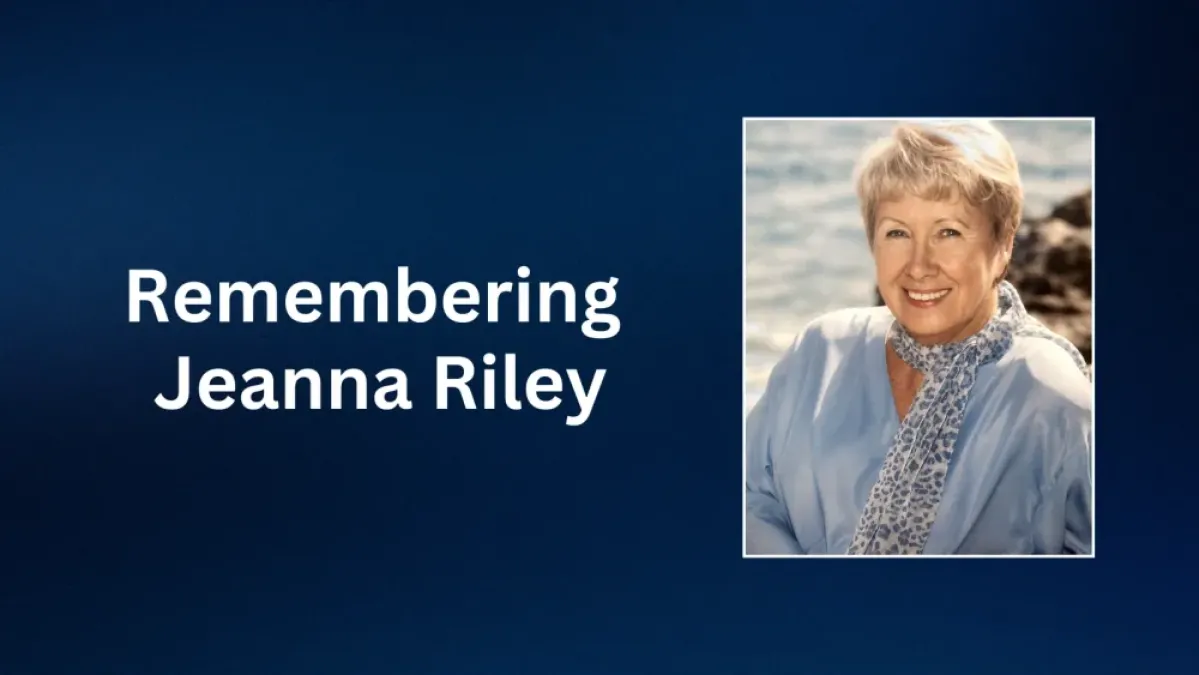
Dr. Jeanna Riley, a pioneering psychologist, speech-language pathologist, researcher, educator, and clinician whose life’s work transformed the understanding and treatment of stuttering, passed away peacefully on June 8, 2026, at her home in Laguna Beach, California, surrounded by her loving family. She was 94.
For more than five decades, Dr. Riley devoted her career to improving the lives of children and adults who stutter. Through groundbreaking research, innovative clinical programs, and compassionate mentorship, she helped shape modern approaches to stuttering assessment, diagnosis, and treatment. Her influence extended far beyond the clinic, touching countless families, speech-language pathologists, and researchers around the world.
Born Rae Jean Norris on May 24, 1932, in Glendale, California, to Edna B. Murphy and Charles P. Norris, Jeanna graduated from Chino High School in 1950. Even as a young woman, she was drawn to psychology and human behavior, a calling she would pursue with remarkable determination while raising a family. She earned a bachelor’s degree in sociology from California State University, Fullerton, in 1967, a master’s degree in speech pathology in 1971, a doctorate in psychology from the California Graduate Institute in 1983, and became a licensed clinical psychologist in 1986.
Her marriage to Glyndon Riley in 1968 began one of the most productive professional partnerships in the history of the stuttering field. Together, the Rileys developed a body of work that continues to influence clinicians and researchers worldwide.
Among their most enduring contributions was the development and refinement of the Stuttering Severity Instrument (SSI), which became the most widely used standardized measure for evaluating stuttering severity in both clinical practice and research. They also advanced the understanding of developmental stuttering through research demonstrating that stuttering is a heterogeneous disorder with multiple contributing factors. Their work identifying subgroups of children at risk for persistent stuttering helped lay the foundation for today’s early identification and intervention efforts. Their Component Model of childhood stuttering anticipated concepts that would later evolve into the capacities-and-demands framework that remains influential today.
The Rileys also translated research into practical clinical applications. Their Speech Motor Training Program provided a research-based treatment approach for young children who stutter, while their NIH-supported clinical trials comparing treatment methods represented one of the largest controlled studies of childhood stuttering therapy conducted at the time. Jeanna also collaborated with Dr. Gerald Maguire and Dr. Riley in developing innovative self-report measures to better understand the personal experience of stuttering.
In 1971, Jeanna and Glyn founded the Riley Speech and Language Institute in Santa Ana/Tustin, California, where they combined clinical excellence with research and professional training for more than three decades. In 1995, together with colleagues Robert Emry and Elizabeth Mechling, they established the nonprofit Center for Children Who Stutter at California State University, Fullerton. The Center became nationally recognized for providing expert diagnosis, prevention, treatment, clinician education, and community outreach, while ensuring services remained accessible regardless of a family’s ability to pay. In 2007, the California Speech-Language-Hearing Association honored the Center with its Program of the Year Award.
Dr. Riley’s contributions were recognized with many of the profession’s highest honors. She became a Fellow of the American Speech-Language-Hearing Association in 1997. In 1998, she and Dr. Riley received the Malcolm Hough Fraser Award for Clinical Excellence from the Stuttering Foundation, recognizing their extraordinary and lasting contributions to the field.
Following Dr. Riley’s death in 2014, Jeanna remained actively engaged with the stuttering community. She continued participating in professional discussions, maintained her deep interest in research, and practiced clinical psychology until 2019, demonstrating an unwavering commitment to serving others well into her late 80s.
Those who knew Jeanna remember not only her remarkable intellect but also her warmth, humility, optimism, and extraordinary gift for listening. Colleagues admired her openness to differing perspectives, her thoughtful mentorship of generations of clinicians, and her genuine belief that scientific rigor and compassionate care must always go hand in hand. As one tribute to the Rileys observed, “Their demonstrable appreciation for different views has provided us with a model of positive attitudes toward other professionals… they elevated the professional dialogue concerning stuttering.”
Dr. Jeanna Riley leaves behind an extraordinary legacy. Through her scholarship, clinical innovation, mentorship, and unwavering compassion, she fundamentally advanced the understanding and treatment of stuttering while improving the lives of countless children, adults, families, and professionals. Her work will continue to shape the field for generations to come.
Posted July 20, 2026