


 Podcast
 Sign Up
 Virtual Learning
 Online CEUs
 Streaming Video Library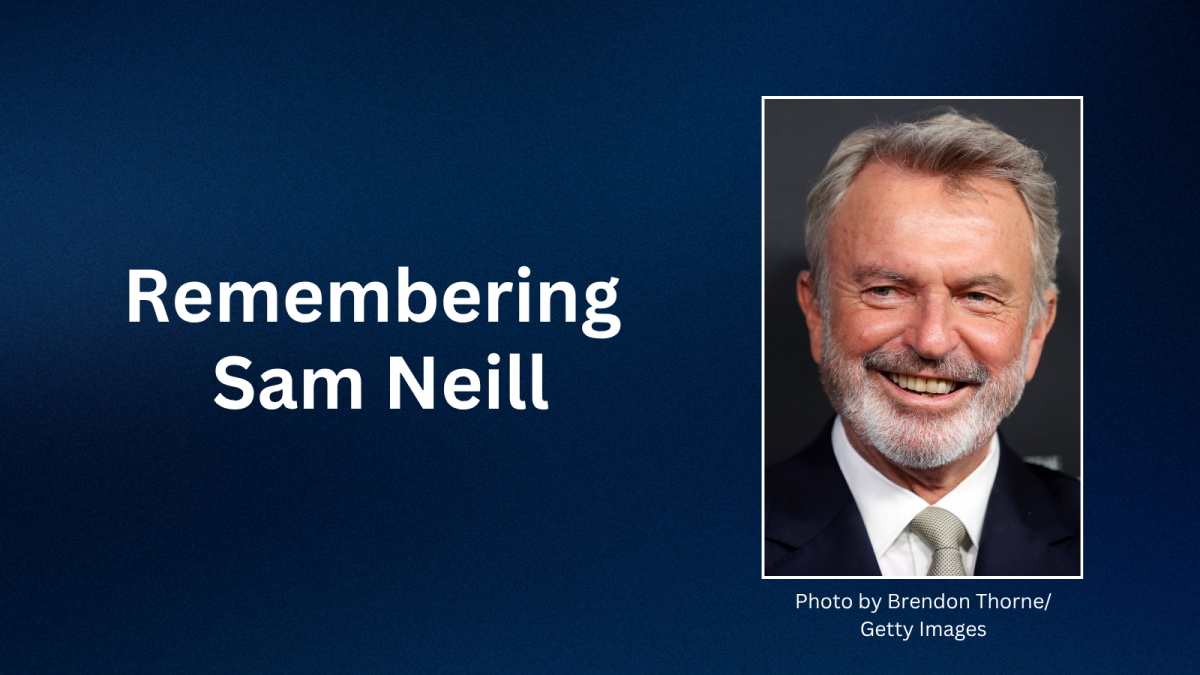
His career spanned more than five decades and 150 roles
Actor Sam Neill's family announced his death in a statement on Instagram, saying, “Sam was surrounded by family and passed with the dignity that has characterized his whole life.” The family noted that his death was sudden and unexpected and that he remained cancer free following several years of treatment for blood cancer, according to NBC News.
Although audiences around the world knew Neill as Dr. Alan Grant in Jurassic Park, the calculating Damien Thorn in The Omen III: The Final Conflict, and for memorable performances in The Piano, The Hunt for Red October, Dead Calm, Event Horizon and dozens of other productions, many within the worldwide stuttering community admired him for something even more enduring: his willingness to speak openly about his lifelong experience with stuttering.
Long before social media made personal stories commonplace, Neill was one of the few internationally recognized actors willing to discuss his speech openly in newspaper interviews and television appearances across New Zealand, Australia, Britain and the United States. For many people who stutter, his candor provided reassurance that success and a speech difference were not mutually exclusive.
Born Nigel John Dermot Neill on Sept. 14, 1947, in Omagh, County Tyrone, Northern Ireland, he moved with his family to New Zealand at age seven, where he would eventually earn a degree in English literature from Victoria University of Wellington before embarking on an acting career. His breakthrough came in the late 1970s and early 1980s, leading to international stardom and a career that included more than 150 screen credits.
But behind the celebrated performances was a childhood shaped by severe stuttering.
“I was pretty silent as a child,” Neill told the Sydney Morning Herald in 2023. “I didn’t really want adults to talk to me because I wouldn’t be able to reply. And it wasn’t until I got to about the age of 14 or 15 that the stutter started to go away. And that coincided with getting some sort of confidence in my life as well.”
Years earlier, during a 2004 interview with Andrew Denton on the Australian television program Enough Rope, Neill recalled that his speech profoundly affected his childhood.
“I always hoped people wouldn’t talk to me so I wouldn’t have to answer back,” he said. “I kind of outgrew it. I can still… you can detect me as a stammerer.”
The Washington Post later reported that Neill first discovered something remarkable as a schoolboy: his stutter disappeared whenever he performed on stage. Acting became not only his profession but, in many ways, a path to confidence.
In his 2023 memoir, Did I Ever Tell You This?, and in reporting by The New York Times, Neill described the challenges of adapting to life in New Zealand as a child. Along with his pronounced British accent and the name “Nigel,” he struggled with a childhood stutter that made fitting in especially difficult. Reflecting on those years, he wrote, “To land in a pretty rough playground in a New Zealand primary school with a plum in the voice and Nigel for a name was asking for trouble.”
Rather than hide that part of his life, Neill increasingly embraced it.
In a 2013 interview with the Daily Mail, he reflected, “I was painfully shy, probably because of it. When people said something to me, I was afraid I’d have to reply so I really didn’t say much.” He also discussed his daughter Elena’s childhood stutter, explaining that her successful speech therapy reinforced his belief that stuttering often has a hereditary component.
“I discovered this because my youngest child Elena stuttered very badly,” Neill said. “We took her to a therapist who asked if there was a history of it in the family. I told her I used to stutter, and after six months of exercises Elena was absolutely OK.”
Neill frequently challenged outdated misconceptions about stuttering. While praising the Academy Award-winning film The King’s Speech, he publicly disagreed with its suggestion that childhood trauma caused King George VI’s stutter.
“As much as I liked the film, I did take issue with it,” he said, according to the Daily Mail. “The idea that a stutter is caused by childhood trauma has been rather discredited. It’s more like a genetic disposition.”
His perspective closely reflected modern scientific understanding and made him a respected voice among speech-language professionals and advocacy organizations.
The British Stammering Association featured Neill discussing the importance of confidence in overcoming the limitations imposed by stuttering. Looking back, he credited growing self-confidence through school, debating, drama and outdoor experiences rather than any single breakthrough.
“There was no particular game plan,” he said. “It just sort of happened organically.”
Neill also supported both the Australian Speak Easy Association and the British Stammering Association, lending his international profile to organizations working to educate the public and support people who stutter.
Professionally, Neill remained one of New Zealand’s most celebrated actors. He earned Emmy and Golden Globe nominations, was appointed an Officer of the Order of the British Empire in 1991, became a Distinguished Companion of the New Zealand Order of Merit in 2007 and accepted a knighthood in 2022.
Following his diagnosis with a rare form of non-Hodgkin lymphoma, Neill approached his illness with the same openness that characterized much of his public life. Speaking with The Guardian in 2023, he acknowledged the uncertainty of his future while expressing gratitude for the life he had lived.
“I can’t pretend that the last year hasn’t had its dark moments,” he said. “But those dark moments throw the light into sharp relief… and have made me grateful for every day.”
He is survived by four children and eight grandchildren.
For millions, Sam Neill will forever be remembered as one of cinema’s most versatile and compelling actors. For countless others who stutter, however, his greatest performance may have occurred off screen—using his own voice to help others find theirs.
Posted July 13, 2026