I Still Have Something to Say
What silence actually contains
Blog by Thinusha Bamunuarachchi
May 21, 2026
A student knows the answer.
The teacher looks around the room, waiting.
The student keeps their head down.
Not because they don't know.
Because they have already calculated what might happen if they try to speak.
The pause.
The word that might not come.
The shift in the room.
By the time they decide it is worth the risk, someone else has already answered.
From the outside, it looks like silence.
From the inside, it is anything but.
We are taught to read silence as absence.
Absence of confidence.
Absence of knowledge.
Absence of interest.
In classrooms, in meetings, and in interviews, the people who speak quickly are often seen as capable. The ones who hesitate are questioned. The ones who stay silent are overlooked.
This assumption is not just inaccurate. It is limiting.
If you assume silence reflects a lack of ability, you are not simply misreading a person. You are narrowing what your environment is capable of producing.
Silence is rarely empty.
Sometimes, it is full of thought that has not yet found a way out.
Sometimes, it is the result of calculation rather than hesitation.
Sometimes, it is what remains after a person has measured the cost of speaking and decided, in that moment, it is too high.
In fast-moving conversations, ideas do not compete on quality alone. They compete on timing.
The person who enters the conversation first often shapes its direction.
The person who needs a moment is left behind.
What appears to be disengagement is often something else entirely.
It is someone waiting for a gap that never comes.
Someone preparing a sentence while the discussion moves on without them.
Someone choosing between being heard imperfectly or not being heard at all.
Over time, this does something subtle.
People adapt.
They contribute less, even when they have something to say.
They stop attempting to enter certain conversations.
They learn how to appear present without being involved.
And gradually, they begin to disappear without ever leaving the room.
This is not a dramatic withdrawal. It is a quiet adjustment to an environment that rewards speed over reflection.
This experience is often associated with people who stammer, where speaking itself can carry uncertainty. But it is not limited to them.
Anyone who has hesitated in a meeting, paused too long in an interview, or chosen silence in a group setting has experienced some version of this.
Silence is not always a lack of voice.
It is often a response to conditions.
When speed is rewarded, reflection is penalised.
When fluency is expected, difference is filtered out.
When contribution is measured by how quickly something is said, we lose everything that takes time to form.
We rarely question this dynamic.
We assume that those who speak the most have the most to offer.
We assume that confidence has a particular sound.
We assume that if something matters, it will be said.
But many things that matter are never said.
Not because they are unimportant, but because the conditions for saying them were never there.
The cost of this is not always visible.
It is not only missed answers in a classroom.
It is missed ideas in meetings.
Missed perspectives in decisions that affect many.
Missed contributions from individuals who have already decided that speaking is not worth the effort it requires.
Once that decision becomes a habit, it is difficult to reverse.
Silence, when repeated often enough, begins to feel like identity rather than choice.
What would it mean to read silence differently?
Not as absence, but as potential.
Not as disengagement, but as something that requires space.
Not as a problem to correct, but as something to understand.
This does not mean forcing people to speak.
It means creating conditions where speaking does not feel like a risk.
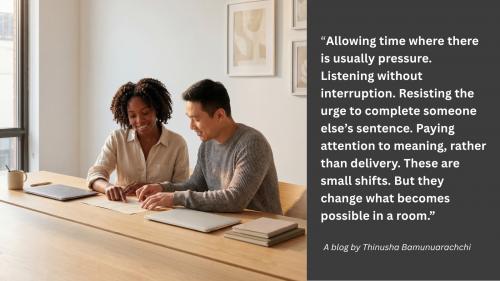
Allowing time where there is usually pressure.
Listening without interruption.
Resisting the urge to complete someone else's sentence.
Paying attention to meaning, rather than delivery.
These are small shifts. But they change what becomes possible in a room.
There is a tendency to focus on fixing the individual voice.
Helping people become more confident.
More fluent.
More comfortable speaking.
These efforts matter. But they address only part of the issue.
The other part is the environment. A voice does not exist in isolation. It responds to what surrounds it.
And when the environment changes, the voice often follows. This understanding did not come from theory alone. It came from experience.
There were many moments when I stayed silent, not because I had nothing to say, but because I did not know how to enter the conversation without disrupting its rhythm.
There were also moments, later on, where something shifted. Where people listened differently. Where time was given instead of taken.
In those moments, speaking became possible.
Not perfect. Not effortless.
But possible.
And that difference matters more than it sounds.
We often talk about giving people a voice.
But most people already have one.
What is often missing is not the voice itself, but the conditions that allow it to be heard.
This is part of what led me to write my book.
Not to offer a solution, and not to present a narrative of overcoming, but to document what it is like to live, study, work, and speak in a world that quietly rewards fluency.
Because silence, as it is commonly understood, is only the surface.
What it contains is far more complex. And far more human.
Thinusha Bamunuarachchi is the author of I Still Have Something to Say, available on Amazon.