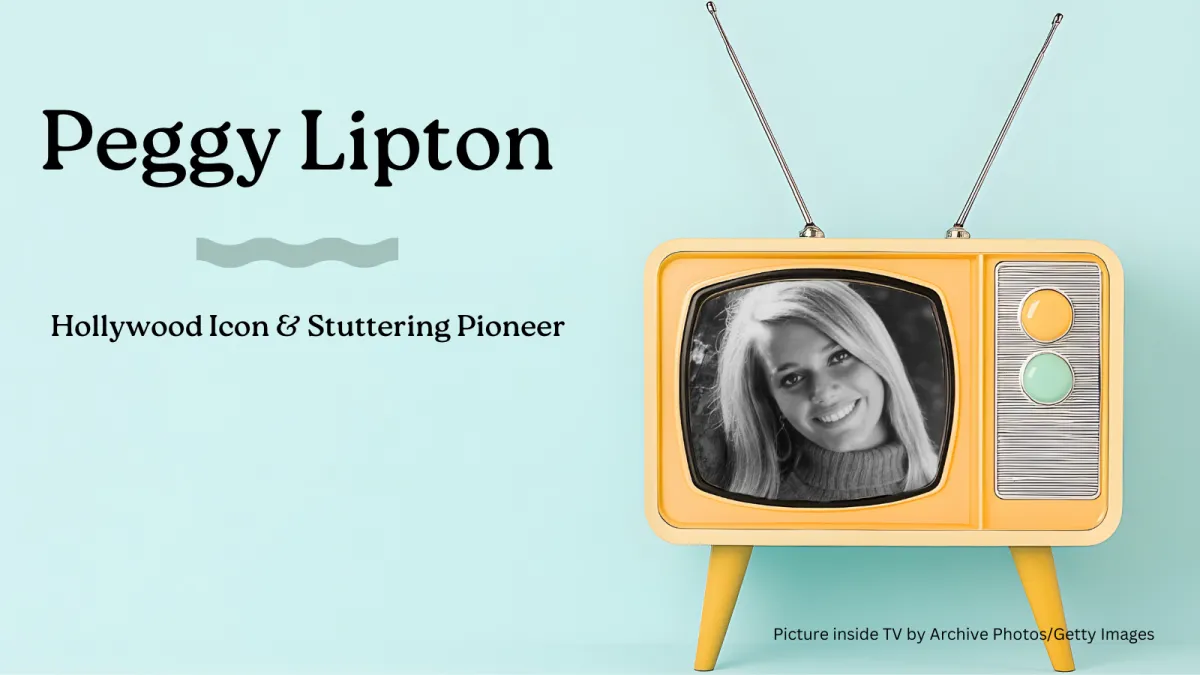
Peggy Lipton: Hollywood Icon & Stuttering Pioneer
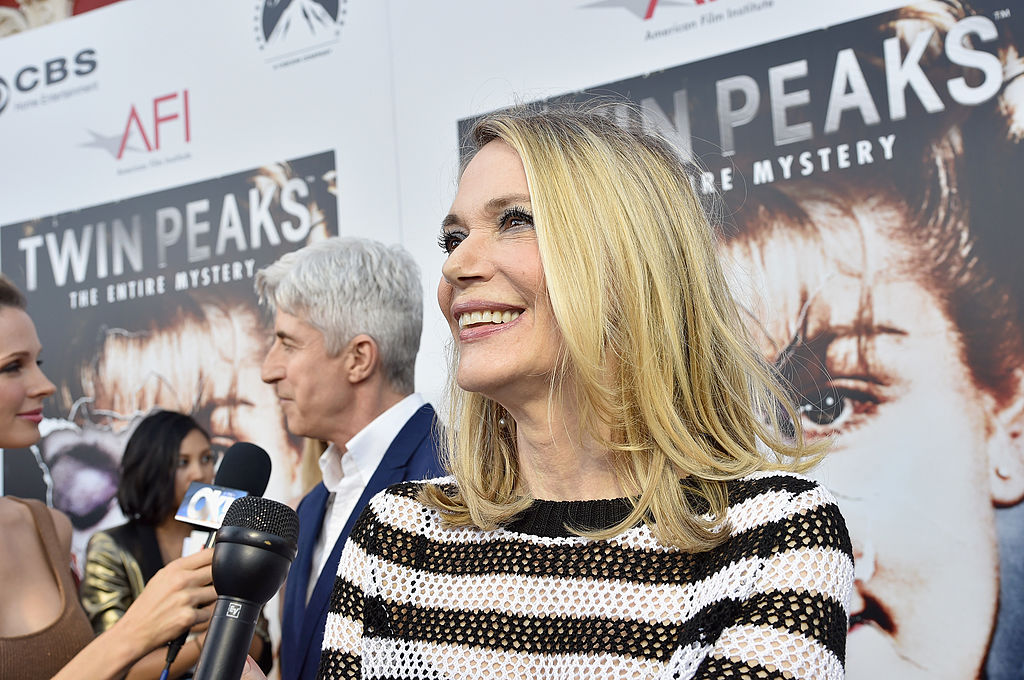 |
| Photo by Alberto E. Rodriguez/Getty Images |
Both the stuttering community and the entertainment industry lost a pioneering shining star on May 11, 2019, when actress Peggy Lipton died of colon cancer at the age of 72. First diagnosed in 2004, she seemingly beat colon cancer and became a public advocate urging people to get a colonoscopy. Tragically, cancer returned and robbed her of her life.
Born Margaret Ann Lipton in New York City on August 30, 1946, to Harold Lipton and Rita Benson, she was raised in an upper-middle class Jewish household in Nassau County, Long Island. Her father was a corporate lawyer and a graduate of Harvard Law School. Her mother, Rita Benson, was born Rita Rosenberg in Dublin, Ireland, as part of Dublin's thriving Jewish community and immigrated to the United States. Through her mother, Peggy would retain Irish citizenship and have an Irish passport.
While still in high school, Peggy started modeling with the Ford Agency and transferred to the Professional Children's School. Moving with her family to Los Angeles in 1964, she signed with Universal Pictures and started having guest roles on numerous primetime television shows such as The Virginian, The Alfred Hitchcock Hour, Bewitched, and The F.B.I. However, it was not until 1968 when she was cast in the Aaron Spelling produced The Mod Squad that she gained prominence and became a household name. The show also started Aaron Spelling's career as a television mogul.
The Mod Squad featured a trio of undercover "hippie cops," all of whom had previous brushes with the law. The show has been described as, "the concept was to take three rebellious, disaffected young social outcasts and convince them to work as unarmed undercover detectives as an alternative to being incarcerated. Their youthful, hippie personas would enable them to get close to the criminals they would investigate."
Lipton played Julie Barnes, a described "canary with a broke wing," who was arrested for vagrancy after running away from her prostitute mother's San Francisco home. The show was a first in that it was a prime-time acknowledgement of the hippie culture and one of the first examples of multiracial casting on television. It catapulted Lipton to television stardom. She was nominated for four Emmy awards in her five seasons on the show and in 1971 won a Golden Globe Award for Best TV Actress in a Drama.
After The Mod Squad went off the air in 1973, Lipton took a sabbatical from acting for 15 years. In 1974, she married Quincy Jones, Grammy-Award winning musician and producer, and the couple would have two daughters, Kidada, an actress, model, and fashion designer, and Rashida, an actress in film and television.
By all accounts in books and magazine articles, Peggy Lipton was a major player alongside her husband when he produced Michael Jackson's famous 1982 Thriller album, which ranks as the best-selling album of all time worldwide and swept the 1984 Grammy Awards. However, Lipton and Jones separated in 1986 and divorced in 1990, though remaining good friends.
With the exception of acting in a 1979 made-for-TV movie of a Mod Squad reunion, The Return of The Mod Squad, Lipton did not return to acting until starring in a 1988 ABC movie Addicted to His Love. At the time in a 1988 profile in People magazine, she stated, "I never had confidence – never. The hardest thing to know is your own worth, and it took me years and years to find out what mine is."
From 1990-1991 there was a resurgence in Peggy Lipton's career as she had a supporting role in Twin Peaks, David Lynch's cult-hit TV show. She played Norma Jennings, the owner of the Double R Diner. In 2017, she reprised the role of Norma Jennings in Twin Peaks: The Return, as well as in the show's spinoffs, including Twin Peaks: Fire Walk with Me.
During her years of fame on The Mod Squad from 1968-1973, it was reported in the supermarket tabloid media on many occasions that Lipton struggled with stuttering. However, it failed to carry over into the mainstream media. In 2005, Lipton published her memoir Breathing Out, which was co-authored by David and Coco Dalton, and went into great detail about her lifelong issues with stuttering.
She titled chapter six "Eggy" and detailed how when she was 13, she and her brother Kenny went away to summer camp and she wasn't able to give her name. "That first day at camp we formed a line, and I had to give my name. I couldn't do it. I couldn't get the 'P' in 'Peggy' to come out. I stood there shaking, my lips trying to get themselves around the consonant. My eyes twitched and danced around my head from the enormous effort. I was summoned to the front of the line. 'Oh, just write your name down on the list,' the exasperated counselor finally said."
She continued to say that years later when she was a model and had to call to photographers to ask if they were interested in seeing her book, she would just say her name was "Eggy. . . ." The people at the other end would usually say "what?" and then stumble through the options until they reached "Peggy."
Chapter nine in her book addresses her stuttering and she begins by saying, "My stutter probably had some basis in physiology, for both my brothers had problems with language. Bob had a disorder that made him stammer. Kenny had dyslexia, the reversing of words, along with a speech impediment that made it difficult for him to grasp and say many phrases."
When she first started her acting career and signed a contract with Universal Studios, she was obliged to take all the jobs to which she was assigned. She wrote, "I was compelled to take all jobs I was given and say lines I couldn't get out because of my stutter. I'd fret and stay awake all night worrying about how to ask the director if I could change or rearrange a sentence just so I wouldn't have to say a certain consonant. A 'p' or 'g' at the beginning of a word made me break out in a cold sweat. With everyone waiting to shoot the scene I was sure the smell of fear was emanating from my pores. Rarely would anyone let me change a line so I would pray and turn completely inside and out with trepidation. I'd stammer, freeze, or fake that I had forgotten the line. I would feel like I was about to pass out, until by a miracle of determination and detachment, I'd catch a wave and ride its smoothness into the moment and dive into the dreaded words. Out they came. I had summoned up the gods. I learned to do this over and over."
Upon getting the role of Julie Barnes on The Mod Squad, Lipton wrote, "After all the struggles with acting and the stuttering and being shuffled around the studios, I finally felt at home on a set. I was one of the stars, which helped alleviate my insecurities. Getting the part of Julie Barnes in Mod Squad gave me a feeling of euphoria."
Later in Breathing Out, she related how her two co-stars, Michael Cole and Clarence Williams III, stood up for her to a demanding director who did not understand her speech difficulties. She wrote, "He'd badgered me when I insisted on changing some lines that I was having difficulty saying because of my stutter. Michael and Clarence demanded an apology for me and got it."
Peggy Lipton was one of the first modern women celebrities who was open about her stuttering and a definite role model. She is remembered fondly by an entire generation who watched her on The Mod Squad, the overwhelming majority of which did not know that she struggled with stuttering. Her 2019 death to colon cancer was a sad day for the entertainment industry, as well as for the stuttering community. Her example of positive energy and triumph over adversity will forever be an inspiration to people who stutter.
From the Fall 2025 Magazine