The President and the Baritone
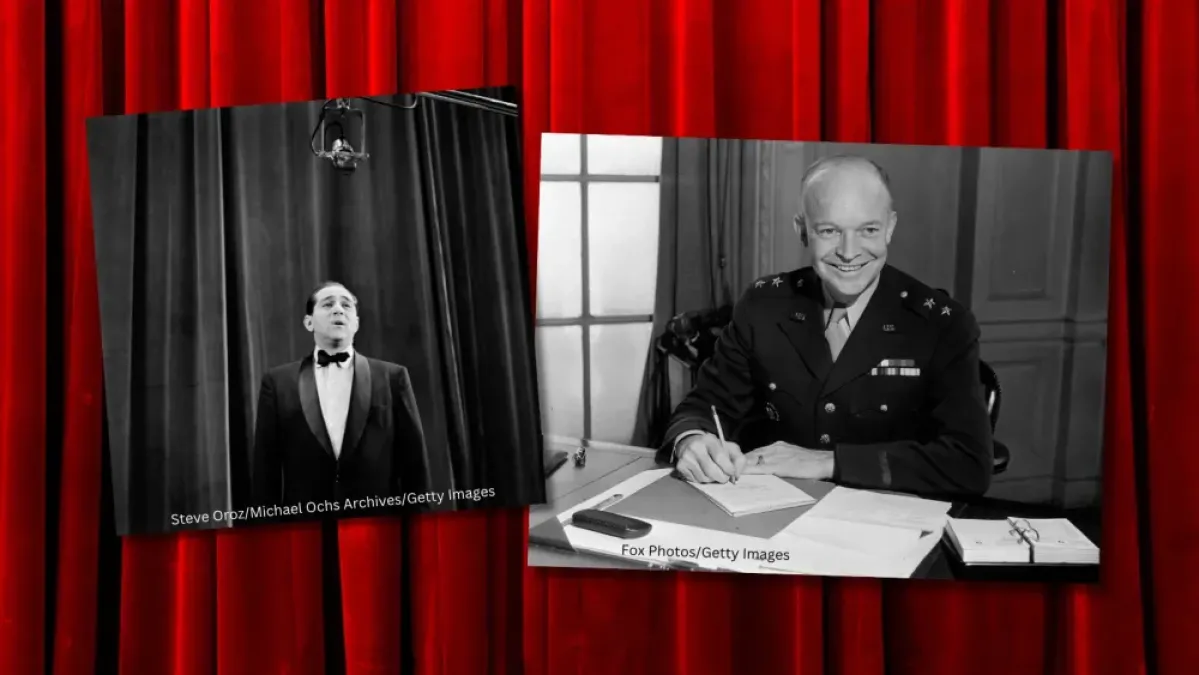
Dwight Eisenhower, Robert Merrill, and a Shared Understanding of Stuttering
Robert Merrill, the celebrated American operatic baritone, spent much of his early life fearing that others would discover he stuttered. Decades later, after his voice had carried him to the Metropolitan Opera and international fame, Merrill became a longtime friend of the Stuttering Foundation and its national spokesperson during the eighth National Stuttering Awareness Week in 1995. In that role, he shared not only his own experience but also the story of an unexpected bond with General Dwight D. Eisenhower, who would become the 34th president of the United States.
As a child, Merrill avoided school whenever possible because he feared being called on in class and ridiculed for his speech by classmates and even teachers.
“No one, not teachers, schoolmates, or even my mother, seemed to understand that stuttering was not something that I could control,” Merrill said. “They thought I was nervous or trying to talk too fast—or, worse, stupid.”
The man who would become one of the greatest baritones of his generation recalled that when his mother asked him to sing for guests and relatives, he would perform only if the lights were turned off or if he could stand alone in the bathroom.
“Stuttering makes you unsure of yourself; it makes you feel that you are really less than you are—which is a terrible thing,” he said.
Born in Brooklyn on June 4, 1917, to Jewish immigrant parents from Poland, Merrill was encouraged by his mother to pursue voice training because he did not stutter while singing. As a teenager working in Manhattan’s garment district, he often passed the old Metropolitan Opera House. After seeing baritone Richard Bonelli sing Count di Luna in Il Trovatore, Merrill was hooked.
He began singing at bar mitzvahs, weddings and Borscht Belt resorts, where he met agent Moe Gale. Gale helped him secure work at Radio City Music Hall and with the NBC Symphony Orchestra under Arturo Toscanini. Merrill studied extensively with vocal teacher Sam Margolis and, after winning the Metropolitan Opera Auditions of the Air, made his Met debut in 1945 as Germont in La Traviata.
His career quickly flourished. Time described him as “one of the Met’s best baritones,” and he became the company’s principal baritone in 1960. Music critic Peter G. Davis later wrote in The New Grove Dictionary of American Music that, in vocal endowment, technical security and longevity, Merrill “was unequaled among baritones of his generation at the Metropolitan.” His New York Times obituary described him as one of the greatest Verdi baritones of his generation, admired for the strength and security of his sound and the precision of his two-octave range.
Merrill celebrated his 500th performance at the Metropolitan Opera on March 5, 1973, and remained on its roster until 1976. His career also extended to radio, television, film, nightclubs and Las Vegas. For 30 consecutive seasons, he sang “The Star-Spangled Banner” on Opening Day at Yankee Stadium, and a recording of his rendition was used for years to open Yankees home games.
Yet even at the height of his career, Merrill never forgot how stuttering had shaped his childhood. He said singing helped him find his own voice and cadence. Although he had not received formal speech-language therapy himself, he strongly encouraged others who stutter to seek help and cautioned that moments of stuttering could recur without warning.
One such moment came while he was meeting the renowned conductor Toscanini. That experience reinforced a lesson Merrill later shared through the Stuttering Foundation: lapses in fluency can occur even after a person has made substantial progress, and they do not erase that progress.
It was another encounter, however, that gave Merrill a particularly powerful story to tell. Early in his career, he performed at an outdoor concert in Denver attended by General Dwight D. Eisenhower, Eisenhower’s wife, Mamie, and his mother. A rainstorm temporarily halted the performance, and the general came onstage.
“We had a lovely, lovely talk,” Merrill recalled. “But I noticed he started some of his sentences in the same way that I did.”
After the concert, the two men discussed stuttering. Eisenhower told Merrill that he had stuttered as a child. “I don’t think he had as much difficulty in childhood as I did,” Merrill said, “but he definitely did have the problem.”
Eisenhower’s path to that Denver stage had been very different from Merrill’s. Born on October 14, 1890, in Denison, Texas, and raised in Abilene, Kansas, he graduated from West Point in 1915. During World War II, he oversaw the Allied invasions of North Africa and Sicily before serving as Supreme Commander of the Allied forces that invaded France and Germany. After the war, he served as military governor of the American-occupied zone of Germany, Army chief of staff, president of Columbia University and the first Supreme Commander of NATO.
Eisenhower was elected president in 1952 and reelected in 1956. By then, Merrill had another opportunity to speak with him—this time while performing at the White House.
“We talked about it again, and I noticed great improvement in his fluency,” Merrill said. “But if you listen to his speeches, you’ll notice that he sometimes hesitates when starting his sentences.”
Eisenhower’s history of stuttering was not widely known. The Stuttering Foundation learned of it through Merrill in 1995, when he recounted their conversations for the Foundation’s spring newsletter. Merrill believed the story deserved to be shared because people who stutter could draw strength from knowing that stuttering had touched the lives of accomplished figures in very different fields.
“President Eisenhower never let stuttering stand in his way,” Merrill said. “It can be a very frightening disorder, but we need to work to overcome it.”
That same conviction made Merrill an effective spokesperson for the Stuttering Foundation. During National Stuttering Awareness Week in 1995, he helped the Foundation share accurate information about stuttering in children and guide teenagers and adults toward effective treatment and support.
At the time, Foundation president Jane Fraser said, “We are very pleased to have someone as our spokesperson who has given joy and inspiration to the world through his own voice. Mr. Merrill did not let stuttering stand in the way of success, and we hope that his message of hope will encourage anyone who deals with a stuttering problem.”
Robert Merrill died at his home in New Rochelle, New York, on October 23, 2004, at age 87. His extraordinary career left an enduring musical legacy, but his willingness to speak openly about stuttering gave the stuttering community something more personal: an honest account of childhood fear, hard-won confidence and the discovery that even a famous general and future president had once faced a similar challenge.
Merrill and Eisenhower found their voices on very different stages—one at the Metropolitan Opera, the other in military command and the presidency. Their intertwined story remains a reminder that stuttering does not determine the reach of a person’s life, leadership or contribution.
From the Fall 2026 Magazine