Now Is the Time for Every Teacher to Learn About Stuttering
Blog by Jane Fraser, President, Stuttering Foundation
Sept. 10, 2026
By now, classrooms are settling into their routines. Teachers are seeing which students raise their hands, which ones hang back, and which children need help finding their place.
In our July 30 post, Students Who Stutter Carry an Invisible Burden, we encouraged teachers to prepare for students worried about introductions, reading aloud, or joining discussions. Now that classes are underway, the burden may be easier to see—if we know what to look for.
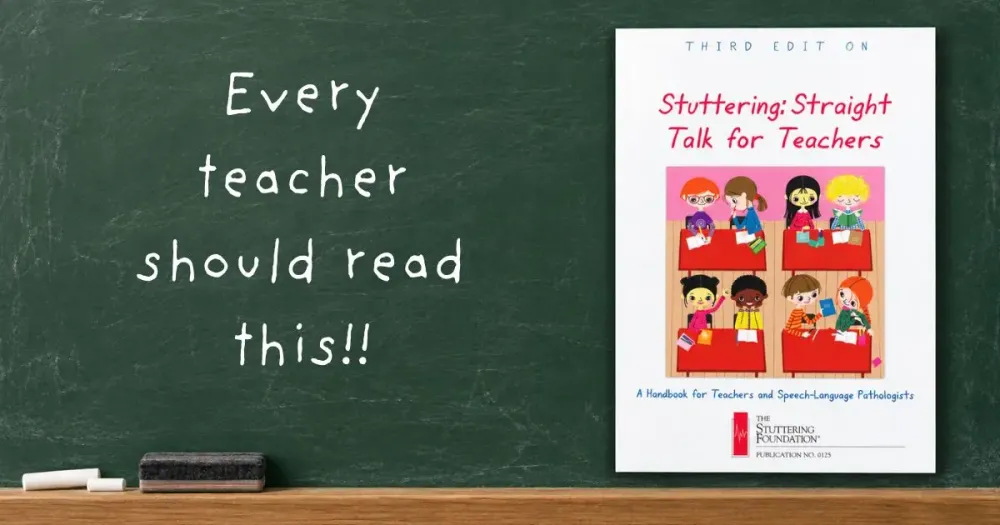
That makes this an important time to read Stuttering: Straight Talk for Teachers.
Teachers may recognize stuttering when a child repeats sounds or becomes stuck. But signs are not always obvious. A student may avoid reading aloud, answer briefly, substitute words, or pretend not to know. What looks like shyness or poor preparation may be a child working hard to hide the stutter.
Our handbook explains what stuttering can look and sound like, how it can affect participation, and when a referral to a speech-language pathologist may help. It also addresses calling on students, oral reports, difficult speaking days, and teasing.
The guidance begins with something every good teacher knows how to do: listen. Maintain natural eye contact, give the student time to finish, and do not supply a word or complete a sentence. Show that you care about what the child is saying, not how fluently it is said.
Advice such as "slow down," "relax," or "take a deep breath" is kindly meant, but can make a child more self-conscious. Speak in an unhurried way, allow pauses, reduce interruptions, and teach the class to take turns listening.
Keep expectations high. Students who stutter have the same range of intelligence and academic ability as other students. Still, fairness does not require handling every speaking activity in the same way.
A private conversation can help. One child may want to be called on like everyone else; another may prefer to raise a hand first. For an oral report, presenting early, practicing with the teacher, or beginning with a smaller audience may help. Ask the student what works and consult the school's speech-language pathologist.
The amount of stuttering you hear may not reveal how much a child is struggling. One student may stutter noticeably and participate confidently, while another quietly avoids words and activities. Pay attention to participation as well as speech.
When teasing occurs, support the child and follow the school's bullying policies. Teachers do not need to become speech therapists. Their role is to give the child room to communicate, protect the child's dignity, and show that stuttering is nothing to be ashamed of.
It is not too late to notice a student avoiding a raised hand, reading assignment, or conversation. A thoughtful response now can shape that child's willingness to participate throughout the year.
Please take a few minutes to read Stuttering: Straight Talk for Teachers and share it with educators and speech-language pathologists. You may never know how much it means to a child who realizes that, in your classroom, there is time to speak—and that every voice belongs.